21 juni 2025 (12 dec)
The following writing, dated June 21, 2025, served as the inspiration for a comprehensive case study on the difference between trauma-related body dysphoria and authentic gender dysphoria in complex trauma.
The article:
Gemaskeerde Genderdysforie bij Complex Trauma: Een Reflectieve Casusstudie over Trauma-gerelateerde Lichaamsafwijzing en Genderdysforie
Is 4 september 2025 gepubliceerd in het wetenschappelijk peer-reviewed Tijdschrift voor Seksuologie en is te lezen via onderstaande link:
https://www.tijdschriftvoorseksuologie.nl/lees/gemaskeerde-genderdysforie-bij-complex-trauma-een-reflectieve-casusstudie-over-trauma-gerelateerde-lichaamsafwijzing-en-genderdysforie
Symptoms of abuse or authentic gender dysphoria?
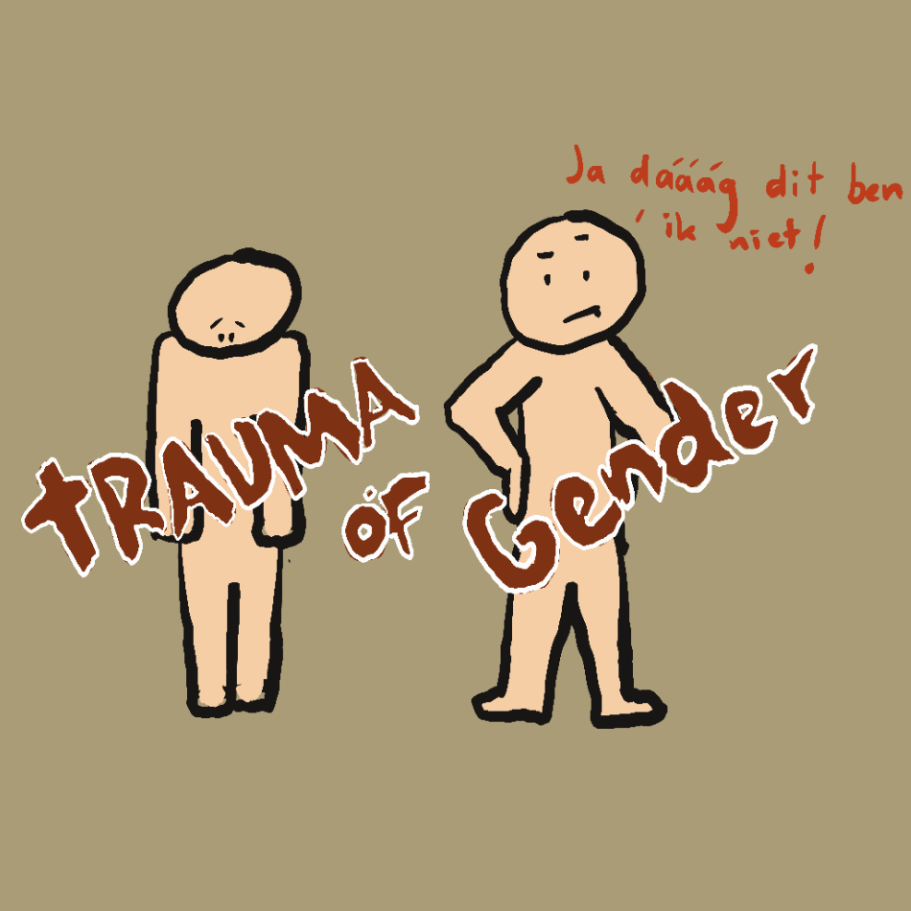
The perceived difference between traumarelated dysphoria resulting from sexual abuse and authentic gender dysphoria.
⚠️ Nuance! I'm not writing this to draw general conclusions about what it must be like for others. But precisely to show that distinguishing between trauma and gender identity isn't a black-and-white question. And that sometimes healing can only create space for who you truly are. This article argues that trauma can sometimes be a clouding of the underlying gender dysphoria, rather than gender dysphoria being a consequence of trauma. And at a time when trauma and gender identity are regularly linked, sometimes in a presumptive or pathologizing way, I want to use this article to offer a different voice: that of a traumatized trans person for whom healing actually created more space for authenticity.
Introduction (Written 21 of june 2025)
I'm a transsexual person (trans man) and I also have a history of child trafficking and sexual exploitation. As I write this, I'm 26 years old, have been using testosterone for about a year, and am on the waiting list for surgery. For years, I thought and hoped that my dysphoria was related to my past abuse. This seemed rational, the most logical. However, nothing could be further from the truth.
Trauma treatment and the recognition of gender dysphoria
During the treatment of my traumatic past, I expected my feelings of dysphoria about my body to diminish. As someone with Dissociative Identity Disorder, my expectation -as described in the literature- was that by integrating trauma and developing a greater connection with my body, I would experience my female body as my own (Merker et al., 2020). However, the opposite happened: The more sexual trauma I processed through traumatherapy, the closer I became to my body. The more I realized that while my body was indeed mine and no longer someone else's property, my own body wasn't the right body. The further I progressed in my treatment, and the sexual trauma receded into the background, the more my gender dysphoria came to the forefront. I longed to be a woman because I had already endured such a tremendous journey in mental health care. I was so tired and exhausted that I had absolutely no strength left for a medical transition. But the healthier I became mentally, the greater the need to become myself became.
The distinction
The distinction between trauma dysphoria (By 'trauma dysphoria' I mean the body rejection that stems from sexual abuse, and which can manifest itself in similar feelings as gender dysphoria, but has a different source.) and gender dysphoria was internally characterized by subtle differences for me. This does not have to be the case for everyone!
Misgendering/Social Aspects
Trauma dysphoria: "I'm a woman/girl to you," "If I were a girl/woman, would you be okay with me?"
Gender dysphoria: "Fuck off I'm not a girl/woman at all!"
Bodily Experience
Trauma dysphoria: "My body is proof that I was property and was at the service of others."
Gender dysphoria: "My body isn't right, and it makes me unhappy."
Sex characteristics
Trauma dysphoria: "This wasn't my property, it's not mine."
Gender dysphoria: "This doesn't feel right to me."
Trauma relapse? Conformation relapse!
The more stuck I was in my trauma brain, the more I questioned my gender identity, and the more it shifted between male, female, or non-binary, as is known in DID (Soldati et al., 2022). My trauma brain dictated that I should feel and behave as my perpetrators expected me to. And that wasn't in line with my own gender identity. Moreover, because of my trauma brain, I was afraid of medical transition. I was afraid that if I started taking hormones, I would never be cared for again because I would then acquire a more adult appearance. Moreover, the burden of trauma was far too heavy to bear alongside the burden of potential transphobia. Because of my trauma, I was unable to stand up for myself and who I am. Postponing hormone treatment while feeling stuck in a traumatic past confirmed for me that my dysphoria was related to who I truly am, rather than the result of sexual abuse.
Because my sexual abuse and past taught me: "Act normally and behave the way I (the perpetrator) want you to."
My gender identity, which I kept to myself, was absolutely not in line with how my perpetrators treated me. And because of my trauma brain, I behaved the way my perpetrators treated me for a long time, before I took the step to medically transition.
Then why are there so many transgender people with abusive backgrounds?
I don't think it's because transgender people are more abused than other people before they transition. It's simply because abuse is a huge problem that occurs much more frequently than is known. This also applies to the transgender population. But dissociation is a phenomenon that is also linked to gender dysphoria (Colizzi, 2015). The difference is that transgender people are under scrutiny, and dissociative symptoms may be more prevalent. But that doesn't necessarily mean this population has experienced more abuse than other people. Statements that transgender people are more likely to have a trauma history are often based on self-reports or screenings without standardized diagnostics for PTSD (Valentine et al., 2023). Research also shows that the trauma-related symptoms that transgender people often report are linked to gender discrimination. The representation of trans and gender diverse people is also significantly overestimated in trauma research due to limited clinical sample size and focus on trans people receiving psychological care (Jaime, 2024; Riedel, 2025; Feil et al., 2023)
Gender identity after medically transitioning
Entering my transition felt daunting; I took a step that went against everything my trauma brain had taught me. For the first time, I didn't choose survival or protection from perpetrators, but me. Today, I feel strong, clear, and firmly rooted in my medical transition and my identity as a man. I know who I am, and who I've always been, even when trauma still overshadowed it.
APA references
Colizzi, M., Costa, R., & Todarello, O. (2015). Dissociative symptoms in individuals with gender dysphoria: Is the elevated prevalence real? Psychiatry Research, 226(1), 173–180. https://doi.org/10.1016/j.psychres.2014.12.045
Feil, K., Riedl, D., Böttcher, B., Fuchs, M., Kapelari, K., Gräßer, S., Toth, B., & Lampe, A. (2023). Higher Prevalence of Adverse Childhood Experiences in Transgender Than in Cisgender Individuals: Results from a Single-Center Observational Study. Journal Of Clinical Medicine, 12(13), 4501. https://doi.org/10.3390/jcm12134501
Jaime, A. (2024, 3 juli). Yale Report Slams Cass Review: “Misrepresents Data” on Transgender Youth. Teen Vogue. https://www.teenvogue.com/story/yale-report-slams-cass-review-misrepresents-data-on-transgender-youth
Riedel, S. (2025, 12 mei). Researchers Say a Pivotal Anti-Trans Study Is Riddled With Flaws. Them. https://www.them.us/story/cass-review-gender-affirming-care-youth-bmc-medical-research-methodology-journal
Soldati, L., Hasler, R., Recordon, N., Clement, M., Köhl, J., & Perroud, N. (2022). Gender Dysphoria and Dissociative Identity Disorder: A Case Report and Review of Literature. Sexual Medicine, 10(5), 100553. https://doi.org/10.1016/j.esxm.2022.100553
Merker, J. B., Hill, S. B., Wolff, J. D., Winternitz, S. R., Ressler, K. J., Kaufman, M. L., & Lebois, L. A. (2020). Posttraumatic cognitions predict distorted body perceptions in women with dissociative identity disorder. Journal Of Psychiatric Research, 134, 166–172. https://doi.org/10.1016/j.jpsychires.2020.12.053
Valentine, S. E., Smith, A. M., Miller, K., Hadden, L., & Shipherd, J. C. (2023b). Considerations and complexities of accurate PTSD assessment among transgender and gender diverse adults. Psychological Assessment, 35(5), 383–395. https://doi.org/10.1037/pas0001215
APA-reference:
Van Stratum, L. C. (2025). Misbruik of genderdysforie? Het ervaren verschil tussen lichamelijke dysforie als gevolg van seksueel misbruik en genderdysforie. Geraadpleegd op (datum), van https://eendeelvanjezelf.nl/transgender/misbruik-of-genderdysforie-/