TPOY-2025-08-07-WET
Science as Gatekeeper: How the Falsification Principle Fails Psychology as a Science
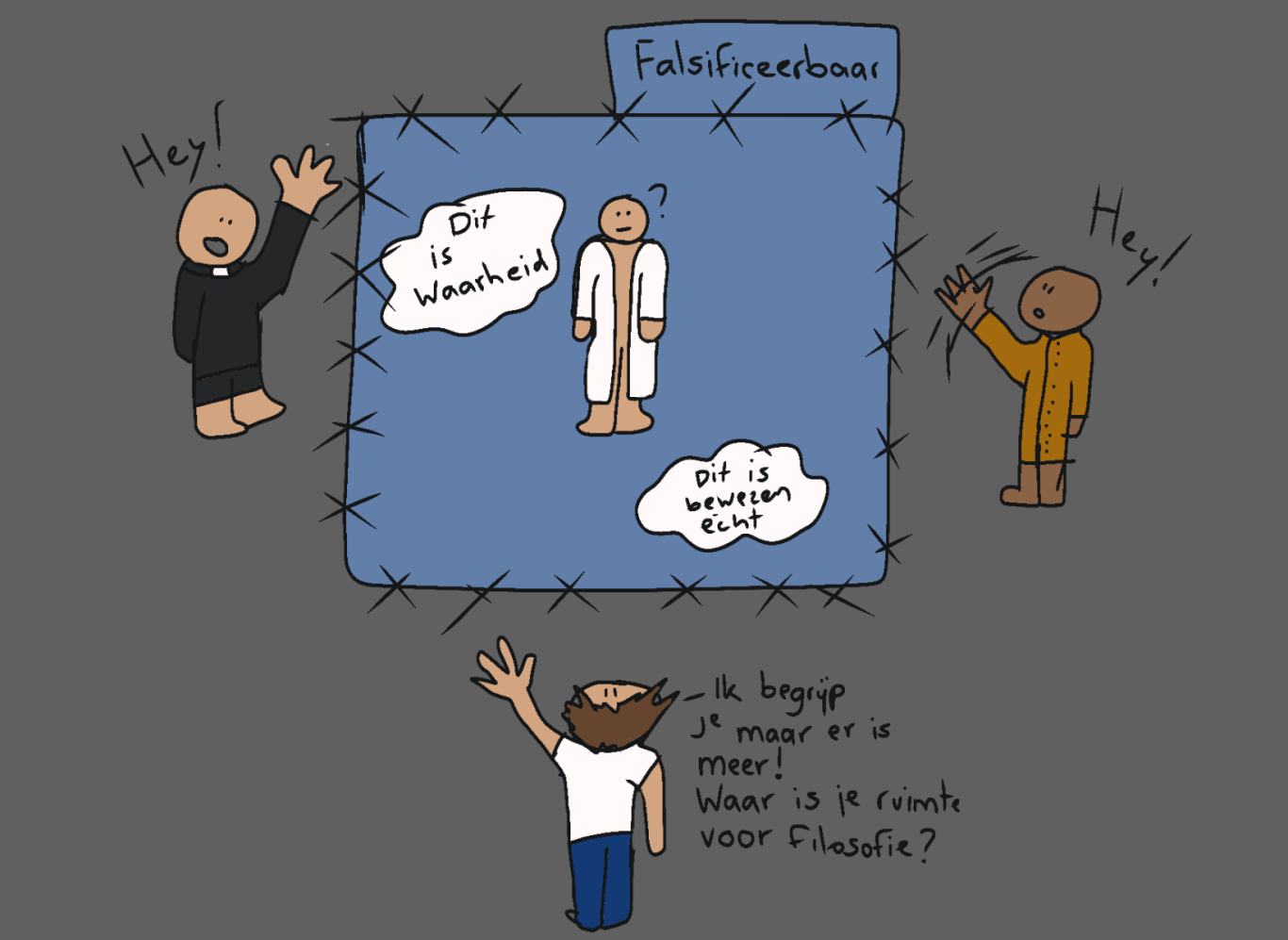
Modern psychological science is built on a single foundation: falsification. Only that which can be refuted in principle counts as a valid object of knowledge in science. This approach has brought humanity many benefits: medicine, technology, precision, and order. But it also comes at a price: a reductionist view of what we consider "reality," in which only that which fits within linear causality counts as real.
For many, this may be a workable model. For some, it falls short. Just as religion or spirituality is a workable model for many, but falls short for some.
The foundation of science: falsification
According to Karl Popper, science is based on falsifiability: something is only scientific if it can, in principle, be refuted. What is untestable falls outside the realm of valid knowledge. Although Popper primarily intended this falsification as a demarcation criterion, it gradually developed into an epistemological monopoly. This approach has led to methodological purity, but also to the exclusion of phenomena that defy linear testing, including many aspects of consciousness, experience, and deeper meaning. In psychology, these are all important phenomena to learn about and understand.
Reductionism as a blind spot
When falsification is the only framework, reality is reduced to what is measurable, provable, and reproducible. There is no room for phenomenology, subjective complexity, or multi-layered meaning-making. Religion is dismissed as dogmatic, spirituality as irrational, inner experience as irrelevant. All so-called pseudoscience. But what if these aren't weak shadows, but simply other manifestations of reality? Truth is domain-dependent: what works in a statistical model or protocol fails in the underlying experience. It is merely another form of knowledge that complements the entire field of knowledge.
Consciousness as multiple space
(My) consciousness functions outside these boundaries. Due to extreme and inhuman experiences in my life, combined with extreme pattern recognition, multiple thinking, and a deep inner attunement necessary to treat DID myself, I don't experience science, faith, and spirituality as conflicting, but as parallel semantic structures. I see no contradiction between the brain chemistry of a mystical experience and its spiritual meaning, which cannot be measured. They are simultaneously true without falsifying each other.
Interdynamiality, intersemy and exology
To explain this awareness, I use my own concepts.
Interdynamiality: the ability to exist between systems of meaning, without submitting to them.
Intersemy: a layer of language in which multiple realities can be expressed simultaneously, without reducing each other.
Exology: the doctrine of what occurs outside the existing human image, yet is experienced from within.
These concepts arose because existing words were inadequate. Just as science is inadequate for this experience.
Science as a part, not as a totality
The fault isn't science itself. The fault is that we use it as the only route to truth or knowledge. This leads to a vacuum, philosophically impoverished care, and the exclusion of people whose experiences can't be captured by data or diagnoses.
Towards a multiple epistemology
What is needed is not a rejection of science, but an expansion of our understanding of knowledge. A multiple epistemology in which falsification is one way to arrive at knowledge, alongside others: resonance, experience, embodied cognition, inner perception, systemic intuition. In such a world, science is no longer the gatekeeper of truth, but a participant in a larger conversation.
Conclusion: Falsification is one language in a multilingual psychological science
My life doesn't feel like a private existence. It feels like a bridge between worlds: between humanity and consciousness, between science and faith, between rationality and meaning. That's not a choice. It's a form of existence that has developed through the interaction between everything I've experienced and, among other things, my ability to recognize patterns.
And I'm certainly not alone, which is precisely why it's necessary that we rethink what "reality" actually means. Because as long as it remains limited to what is falsifiable, entire layers of humanity remain invisible, or worse: unthinkable. And in psychology, reduced to something that only fits within certain frameworks. And no longer something that encompasses humanity as a whole. As long as truth remains trapped in what we can measure, the immeasurable parts of humanity remain prisoners of disbelief.
APA-verwijzing:
Van Stratum, L. C. (2025). De wetenschap als poortwachter: over het probleem van falsificatie en de uitsluiting van andere werkelijkheden: Hoe het falsificatieprincipe de psychologie als wetenschap tekortdoet. Geraadpleegd op (datum), van https://eendeelvanjezelf.nl/het-idealistisch-bewustzijn/het-falsificatieprobleem/