TPOY-2025-13-06-SPG
When persuing your dream education hurts
Parallels between profound giftedness, school trauma and chronic distress
Some nuance upfront!: In this article, I describe how my experience within the educational system led to psychotrauma. Although the system proved unsafe for me, I want to explicitly mention that there were exceptions. One teacher in particular did see me in my way of thinking. She was a beacon of light for me. This article is therefore emphatically not a judgment of individuals, but an attempt to interpret my experience and its consequences within the larger context. I am sharing this because I want to offer recognition to other exceptionally gifted individuals and contribute to societal awareness of this debilitating form of psychotrauma.
As well as I was able deal with my past with sexual abuse, I felt equally defenseless in the face of my school trauma. In the article "School is essspessially hard", I offer insight into the mismatch between my brain and the school system. This article expands on that, focusing on the psychotraumatic aspect of this mismatch. And for those who, after this introduction, are wondering: "How on earth can you compare your abuse trauma to a school trauma?!" Trauma is not the event itself, but the way in which the nervous system becomes either acutely or chronically overloaded and disrupted. Often precisely because there is no perceived escape from the situation..
When does studying become unsafe for your brain?
To illustrate, here are two case studies of chronically persistent unsafe situations.
Example 1: Person X grows up in a family where his true feelings, thoughts, and needs are consistently ignored, suppressed, or dismissed as “nonsense.” Person X learns that he will only receive love, safety, or the right to exist if he conforms to the family norm, if he represses his emotions, censors himself, and swallows his truth. In order to cope with this separation from who Person X can be at home, he begins to dissociate from his true self. He becomes convinced that something must be wrong with him. Because when he tries to be himself in the family, he is punished and looked at strangely because he can’t “just act normal.” Person X learns to reject himself in exchange for a place in the family.
Symptoms:
Person X suffers from nightmares, avoids social contact, can suddenly feel paralysed with fear without any clear cause, and also experiences identity confusion and low self-esteem. Person X is eventually diagnosed with Complex PTSD.
Example 2:
Person Y wants to become a psychologist and is brimming with passion and ideas about the field. But to become a psychologist, person Y still needs to study for seven years. In primary school, person Y experienced that his true feelings and needs were consistently ignored, and his way of thinking was dismissed as wrong. When classmates gave presentations, there was applause, but no one ever clapped for person Y. This pattern repeated in secondary school, as well as in vocational education (MBO), and higher professional education (HBO). Throughout these years, person Y held on to the hope that he could be himself when he would study psychology. Because psychology is his passion.
In his psychology study, person Y discovered that his novel ideas and way of thinking were consistently ignored, suppressed, or dismissed as "untrue." This pattern intensified in the psychology master's program. Throughout the years, person Y learned that he would only receive recognition or a right to exist if he conformed to the norms of his studies, if he suppressed his emotions, censored himself, and swallowed his truth. Despite the substantive love for psychology as a science and a way of helping people, the form in which this knowledge is taught is experienced as fundamentally unsafe by Person Y. The institutional nature of the university, with fixed curricula, assessment systems, and limited space for epistemic diversity, further contributes to this unsafe state. In order to deal with the gap between his love for psychology/his dream of becoming a psychologist, and who he is allowed to be within the psychology program, Person Y begins to dissociate from himself. He becomes convinced that there is something wrong with him. Because when he tries to be his passionate self for psychology in school, he is punished and looked at strangely because he can't "just follow the norm." Person Y loses connection with his passion for psychology and learns to reject himself in exchange for a path to becoming a psychologist.
Symptoms: Person Y often suddenly becomes paralyzed with fear when confronted with his studies, regularly suffers from intrusive panic attacks related to his studies, experiences an increase in identity confusion and memory problems, has nightmares about his studies, experiences interactions with people from the university as threatening, avoids contact with his studies as much as possible, also develops depressive symptoms and is very irritable. There is a chronic pattern of invalidation and perceived violation of integrity. Person Y meets all the characteristics of Complex PTSD.
Nuance
(not everyone with school trauma also develops (c)PTSD, trauma can manifest itself in many different forms, this is just an illustrative example)
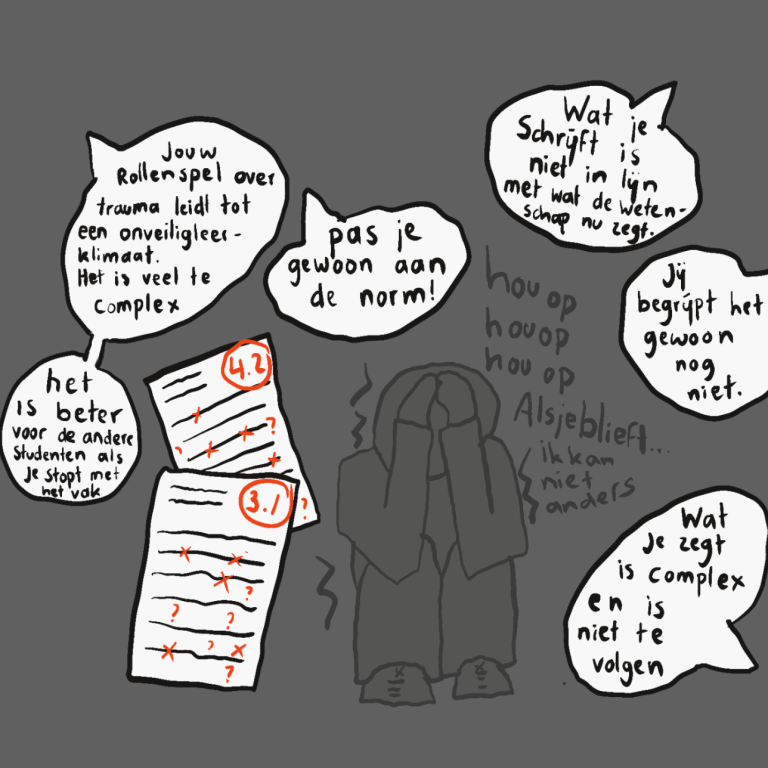
Explanation for psychotrauma as a result of chronic (study) adjustment.
A brain that is structurally forced to suppress and adapt itself for years becomes severely disrupted. This is not an annoying discomfort 'that just comes with the territory', this is a form of psychotrauma, which in severity and neurological impact is comparable to what we can see with chronic relational trauma or complex PTSD. And consciousness cannot continue to function and develop in the situation if it does not distance itself from the 'self' that is in the experienced unsafe situation. For example, several articles on the exceptionally (160+) & extremely or profoundly gifted (180+) show that this target group generally struggles more with depersonalization, trance-like states and identity confusion as a result of study and their forced adaptation to society (Gross, 2011; Pixten et al., 2023, Davidson Institute, 2025).
A war inside
During a symposium organized by the Gifted Foundation, I was so impulsive as to raise my hand during the Q&A session with PG expert P. Susan Jackson. Shaking and crying, before I knew it, I said in front of the entire room...
"It's my dream to become a psychologist. I'm doing my masters in clinical psychology, and I've been studying and trying to adjust to the educational system for over seven years. Everybody keeps saying, you are almost there just hold on for a little longer, but it made me completely lose myself, I don't know how I can hold on any longer"
Even the one lecturer who was willing to embrace my way of thinking in the program, I now prefer not to associate with as "my university teacher." Because the transference would make me anxiously interact with her eventhough she has become a special friend after. I hate to admit it, but my dream education traumatized me.
Conclusion
Recognizing this form of psychotrauma will hopefully one day open the door to more appropriate support, not only within mental healthcare, but also within the educational system itself. It's time we recognize that the structural suppression of epistemically unique forms of thinking is not a learning process, but a damaging social process that can leave deep neurological scars.
References in APA:
Davidson Institute. (2025, 7 april). The intellectual and psychosocial nature of extreme giftedness. https://www.davidsongifted.org/gifted-blog/the-intellectual-and-psychosocial-nature-of-extreme-giftedness/
Gross, M. (2011, 15 september). The "Me" Behind the Mask: Intellectually Gifted Students and the Search for Identity. SENG. https://www.sengifted.org/post/the-me-behind-the-mask-intellectually-gifted-students-and-the-search-for-identity
Pinxten, W. L. F., Derksen, J. J. L., & Peters, W. A. M. (2023). The Psychological World of Highly Gifted Young Adults: a Follow-up Study. Trends in Psychology. https://doi.org/10.1007/s43076-023-00313-8
APA-reference:
Van Stratum, L. C. (2025). Wanneer studeren pijn doet: Parallellen tussen schooltrauma bij uitzonderlijke begaafdheid en chronische onveiligheid. Geraadpleegd op (datum), van https://eendeelvanjezelf.nl/uitzonderlijk-begaafd-pg-/droomstudie-werd-trauma