TPOY-2025-06-06-OMV
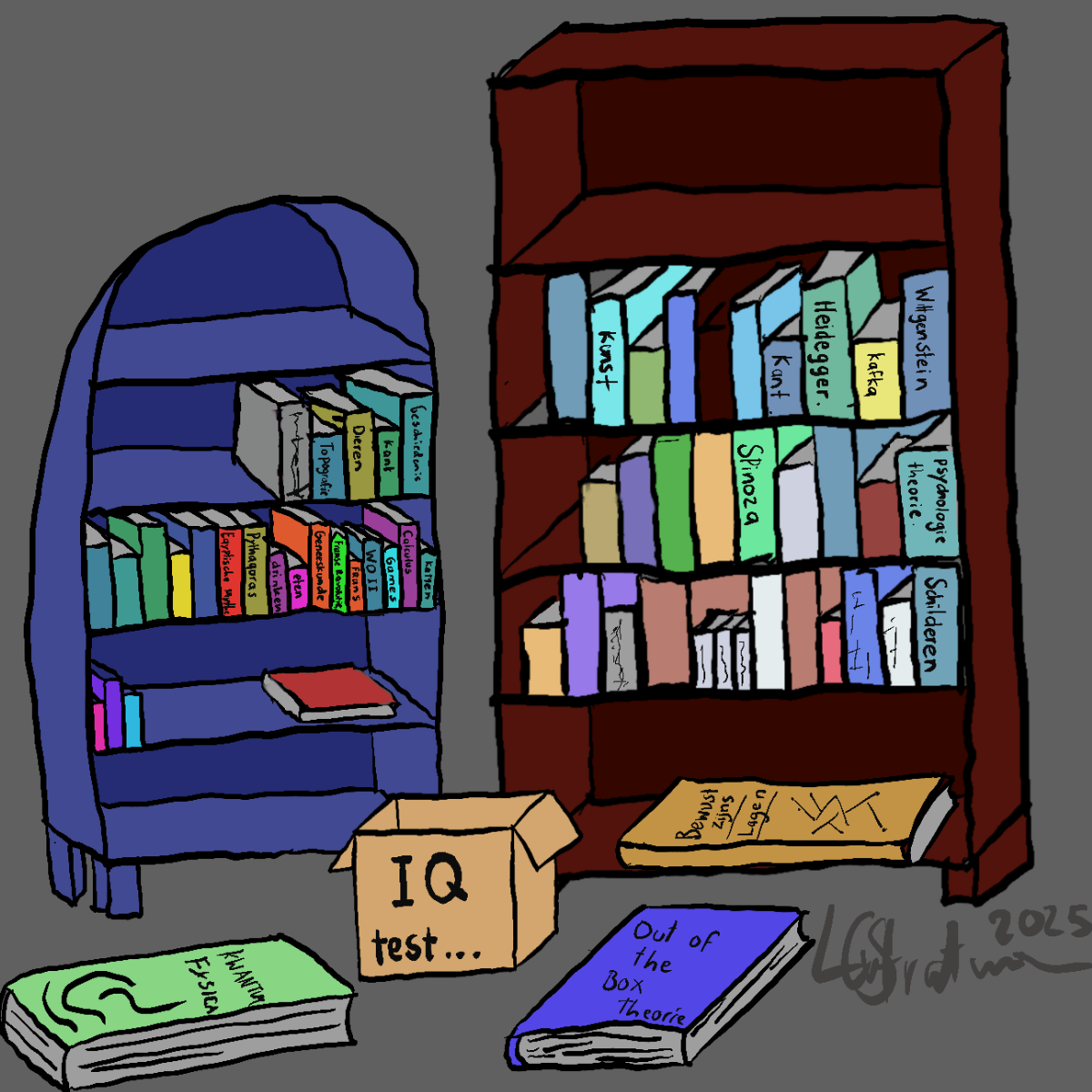
The big problem is that we assume linearity with IQ. But intelligence, capacity, and how this relates to consciousness are anything but linear. Just like this article, which lacks structure.
It doesn't matter where you start reading this article -left, right, or in the middle- just try it.
Things like experiential knowledge influence how intelligence and consciousness develop. Because they are dynamic processes that continuously interact.
I've experienced a lot of terrible things, which meant I had to reinvent myself time and time again, constantly pushing the boundaries of what my informationprocessing could handle. There's certainly an innate component, but it's NOT measurable. Because these intense experiences shaped my consciousness, and thus my capacity, into what it is today. An IQ test makes it look like we're measuring intelligence. Because the psychometric model uses simple statistics. So something linear always emerges because the boundaries simply don't stretch beyond linearity.
The cardbord box analogy
If you only have cardboard boxes, you can put your books in them. For at least a limited number, and some books are too big for the box, so those are out of the question. But your bookcase won't fit in there anyway.
However, that doesn't mean your bookcase isn't the place where you normally keep your books. While those cardboard boxes are still square and cardboard. But yet every bookcase and its contents are different: the size, the color, the material, the weight, etc. So... what does the content of that cardboard box say about the series of books that didn't fit or only partially fit in that box, while they can be nicely and stably sorted by color in your unique bookcase? Or what does it say about others if exactly all the books from your bookcase fit in the cardboard box?
Whether you have a lot of small books or books that fit perfectly, or a few oversized books that don't fit in the box, that cardboard box doesn't say anything about the size/volume of your bookcase and its contents. Because your information processing is much more unique/dynamic than a cardboard box.
Immeasurable intellect
Why an IQ test can't measure intelligence.
I don't think the ability to think outside the box is measurable. Because as soon as you try to, the measuring instrument becomes the 'box'. Giftedness is often characterized by the ability to think 'out of the box'. But that is then 'measured' with 'a box'. So the further you naturally think 'out of the box', the less you will be able to recognize that 'box'.
An IQ test is developed for the norm, and by the norm. Someone who falls outside that norm cannot develop an IQ test for the norm. Because their information processing methods are then divergent. So the question remains...: Who is that norm? And does it even exist? Or do we simply assume that we can map a multidimensional concept like intelligence with unidimensional psychometrics?
Someone with mild intellectual disabilities according to an IQ test. Can develop skills through different information processing (such as excellent mirroring/imitating), allowing them to outsmart others, simply because the so-called 'norm' doesn't immediately recognize this different way of processing information. An IQ test simplifies what can't be simplified. Example: If you were to test my IQ a few years ago, I would have scored very low. This is because I have DID (a disorder characterized by memory loss). So, I would have scored noticeably low on the memory tasks. However, now that I'm further along in my recovery from my DID, my memory is much better. And the results of my memory task will be different. Something that, according to the test-retest reliability of an IQ test, shouldn't be possible in such close succession. And while DID is an extreme example, people are dynamic in the smallest differences that a statistical model will never be able to distinguish. Yet, it can cripple someone's ability.
Example (WAIS): Someone who dropped out of school early will score lower on the Verbal Comprehension Index. However, that doesn't necessarily say anything about someone's developmental potential. If you never learned who a specific important historical figure is (example from the WAIS-IV), then you already score lower, does that mean you're less intelligent? For example, I immediately dropped some subjects relevant to the IQ during my secondary education (VMBO) and never took them again. If I were to take the WAIS-IV, my trivia knowledge certainly wouldn't save me. :-)
APA reference:
Van Stratum, L. C. (2025). Onmeetbaar vermogen: Waarom een IQ-test geen intelligentie kan meten. Geraadpleegd op (datum), van https://eendeelvanjezelf.nl/uitzonderlijk-begaafd-pg-/onmeetbaar-vermogen/