TPOY-2025-06-06-ASV
Arrogant piece of shit :)
About the right to exist as a profoundly gifted being
"Whatt did he just say?! He said he is profoundly gifted? Tsssss. Ugh, yuck, yuck. So fucking arrogant. What the eff mann!"
The recognition and acknowledgement (by an international giftedness expert) of my ehh 'being' extends to being profoundly gifted (PG). For which there's no Dutch translation yet. But whose IQ is estimated over 180 (Sallin, 2024). What now? Am I cancelled for good now :)?
You know what this is... It's simply a part of our raison d'être.
Look, if you have autism (or are autistic, whatever you want to be called) and therefore have a so-called "neurodivergent" brain, then you also want to be able to say: "My brain processes information differently, and that's why I can encounter challenges, because I have autism." And someone can have varying degrees of autistic brain. That applies to varying degrees of giftedness as well. If you are gifted, you experience different challenges than if you are exceptionally gifted, and different challenges again if you are profoundly gifted.
I've heard other gifted people say, "People who say they're gifted aren't by default." There's a tremendous amount of value judgment and almost shame attached to that statement. However, if you're profoundly gifted or otherwise gifted, you're not superior or anything like that. Quite the contrary... my grades at university were between a 5.5 and a 6, and often only AFTER the resit, because that was usually a 4. (Read: School is esspessially hard)
For me, nothing felt superior about that. More like whining on the couch with a tub of ice cream about how poorly I fit into the parameters of society. While I so desperately wanted high grades. But my mind didn't recognize the way of thinking that was demanded of me at university.
In mental healthcare, I always said: You can't ask someone with an intellectual disability to speed up. Anyone who demands that of someone with intellectual disabilities is incredibly harmful to that person.
In the same sentiment, you can't ask me to slow down!
Because that's incredibly damaging to my mental health. It's not a matter of not wanting to, or feeling too good about myself, or any of that nonsense. It's a matter of NOT being able to. Because if I try, I mentally disintegrate and become very unpleasant to interact with. Just like someone with an intellectual disability who is constantly being asked to do more and faster. That wouldn't do you any good either.
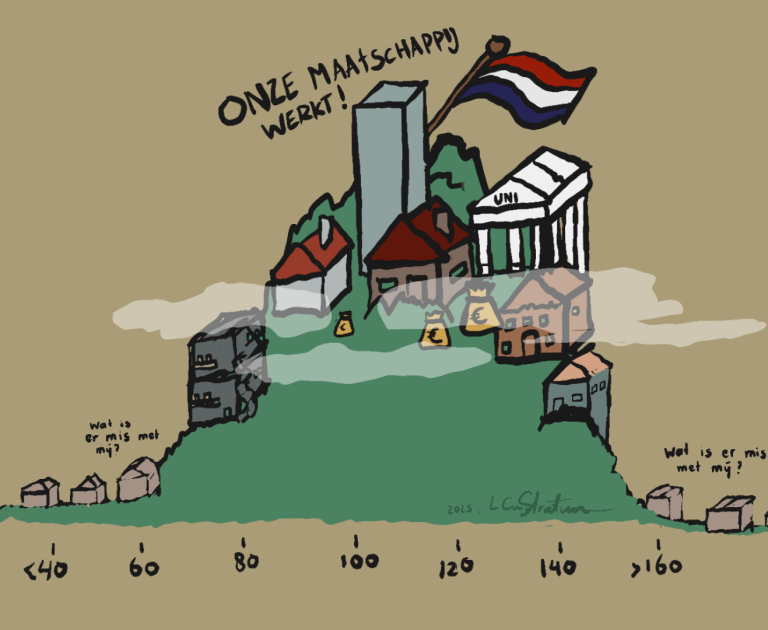
Whether you sit all the way to the left or all the way to the right of the normal distribution, the reality is that society is not structured to nourish different ways of processing information.
References in APA 7:
Sallin, J. H., (2024, 3 juli). High, exceptional & profound giftedness. InterGifted. https://intergifted.com/high-exceptional-profound/
APA reference:
Van Stratum, L. C. (2025). Arrogant stuk vreten :) Over bestaansrecht in het zijn van uitzonderlijk begaafd (profoundly gifted). Geraadpleegd op (datum), van https://eendeelvanjezelf.nl/uitzonderlijk-begaafd-pg-/arrogant-stuk-vreten-/
Te veel
Altijd te veel,
Terwijl ik dacht dat ik te werk ging met een penseel.
Ik wist van binnen dat ik anders was, ik zag de wereld door dubbelglas.
Vanbinnen gebeurde er zo veel processen zo bewust.
Een kruistocht van innerlijke onrust.
De buitenkant enthousiast, doch eenzaam te werk, ik deed zo mijn best.
Maar ik was anders dan de rest.
Ik leefde in mijn eigen spel, een geheim met actoren.
Overgevoelig ten top, overal had ik sensoren.
Bewust van metaprocessen, dat verwacht je niet van een kind.
Waarom heeft niemand mij door? Zijn ze blind?
Elke keer bang om door de mand te vallen.
Gezien werd ik niet, want ik ben slecht met getallen.
Elke dag spookt er door mijn hoofd, de zin die mij verdoofd.
Want een meta brein, met zo veel pijn.
Wat als....
wat als ik was gezien in mijn zijn?
Te veel...
Die woorden grijpen mij nog altijd naar de keel.
Want het rijmt niet voor niets op ontwikkelingspotentieel.
- Pte, 2020 (31-05-2020) (LC)